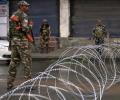
The Jammu and Kashmir government has declared the publication of 25 books as forfeited for promoting false narratives and glorifying terrorism. The books include those written by famous authors like Moulana Moudadi, Arundhati Roy, A G Noorani, Victoria Schofield and David Devadas.

'I hope we can move towards peace, stability, and national unity.' 'I believe most Kashmiris want that too.'

Police conduct raids at bookshops in Kashmir to seize banned books promoting false narratives and glorifying terrorism, following a government order. The ban and subsequent raids have drawn criticism from authors and political leaders.

The transformative improvement promised in Jammu-Kashmir remains largely a mirage, observes David Devadas on the second anniversary of the Constitutional changes in the former state.
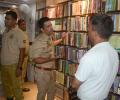
Bookstore owners were cautioned against keeping or distributing the books. Police personnel briefed the bookstore owners about the legal consequences of violating the ban.

David Devadas, journalist, and author of In Search of a Future, the Story of Kashmir, was beaten by the police in Srinagar on last Monday. Devadas says that he is worried about his life after the incident.

In his book Shadow War -- The Untold Story of Jihad in Kashmir, Pakistani journalist Arif Jamal, unveils the involvement of Pakistan in the insurgency and provides some new and quite startling details of the jihad that Pakistan waged against India in Kashmir.
The Shakti Bhatt First Book Prize is the only Indian prize that honours a first-time author. The award carries a cash prize of Rs 1 lakh.
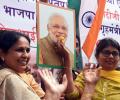
The new legislation on J&K puts a cloud over the state's constitution, through which the state became `an integral part' of India, says David Devadas.

'...by stopping its promotion of turmoil, its aid and abetment to militancy.' 'Mr Vajpayee paved the road for peace by engaging Pakistan tirelessly while also reaching out to Kashmiri leaders and people at large.' 'Like so often in the past, this government does not have a policy. No consistency in approach.'
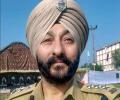
Why did RA&W hire a man with a questionable record, wonders David Devadas.

'The new generation of teenagers which has taken the forefront is largely an amorphous, leaderless mass.' 'It is extremely difficult to find a representative with whom to negotiate now, unless one turns to a militant leader.'

'Terrorists are killing ordinary citizens, huge crowds brave a pandemic to attend militant funerals, and artillery is booming on the LoC.' 'This April seems like a run-of-the-terror-mill Kashmiri spring: Violence is emerging like a prickly new bud,' warns David Devadas.

It has been obvious that the Sino-Pak axis would conspire to weaken India's sovereignty in Jammu and Kashmir, if not wrest Kashmir, says David Devadas.
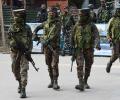
The days of a thousand cuts are over. These mini wars will remain under the threshold of undeniable war, but will escalate closer to that threshold when their big brother pushes in. Chinese aggression has changed the matrix, the strategies, and surely the objectives too, warns David Devadas.

As the campaign peaked, AAP leaders evidently realised they had to deflect their chief opponent's attempts to polarise the electorate over religious identity, explains David Devadas.

'Those who have not lived and imbibed the social and cultural patterns of Kashmir cannot quite fathom the importance of inter-personal communication in Kashmiri society,' says David Devadas.

Threats were often communicated to Pandit homes through notes tied to stones chucked through a window, or a notice pasted on a wall. Those sometimes came from neighbours eyeing that Pandit family's property. Those threats often worked in the atmosphere of terror during that awful season of vacuous exercise of State authority, writes David Devadas, longtime Kashmir watcher and author of two books on the Valley.
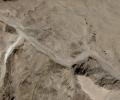
The Chinese probably thought that brutal assault was a knock-out, but they had not counted on the ingenuity, loyalty and courage of battle-trained Indian officers and jawans.
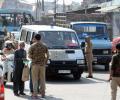
Squashing erstwhile 'separatists', marginalising the 'mainstream', and squeezing funding channels have all evidently had an impact -- at least for the moment, notes David Devadas after a visit to Srinagar.
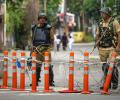
A lot of the factors towards which the government has pointed to justify its moves on Jammu and Kashmir are in fact valid. Only, most of them have little to do with Article 370, says David Devadas.

In the early part of the Kargil operations, the army opted to more or less go it alone, sacrificing large numbers of men and officers in almost superhuman struggles against an enemy on higher ground. Some generals seem to think their predecessors would have succeeded better if they had had air resources at their disposal, points out David Devadas.
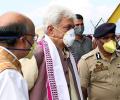
Some of the BJP panches and councillors who attended the meeting with Manoj Sinha said they were not impressed with what the new lieutenant governor told them.

Making citizens queue to vote just when the disease is declining, but is still in the air, could just cause a fresh spurt. The logic for this scheduling is inexplicable, especially since the entire process could so easily have been pushed back by three weeks, argues David Devadas.
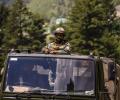
The Indian Army's Northern Command would be stretched if all three of the corps under it -- based in Leh, Srinagar, and Nagrota (near Jammu) -- were to face hostilities, notes David Devadas.

Women will have a decisive say as chairpersons in seven of Jammu and Kashmir's 20 districts.

Future, even present, wars -- at least those involving such tech giants as China -- include hi-tech battlefields, which a Pakistan-obsessed India has not sufficiently prioritised. Today's generals plan on how to disrupt an enemy city's power supplies, rail networks, airports, ports, and government departments, not just by bombing or torpedoing them; they also examine the option of tripping up the computer networks that run these, notes David Devadas.

What the election demonstrated is that the BJP has a stranglehold on most of the Hindu votes in the Union territory, observes David Devadas.

The government must figure out what the Chinese game plan is and thwart the endgame before it is upon us, possibly in early winter, advises David Devadas.
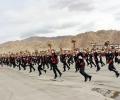
A senior officer confirmed that the Indian soldiers fought valiantly and with tremendous grit "till the last", even to the extent that half of them died in battle, reveals David Devadas.
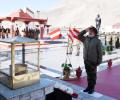
Lieutenant General Harinder Singh, who commands the 'Fire and Fury' 14 Corps, has the experience and talent to face down the Chinese challenge. The general is a rare combination of thinker and tough-minded doer, observes David Devadas.

The valley is under the iron grip of the armed forces and Pakistan does not have the military power or political support to change the status quo, observes Colonel Anil A Athale (retd), after a recent visit to Kashmir.

'In order to restore things to even keel, the government would be very well advised to cut its current political losses and work towards healing wounds across the nation. It still has its work cut out. It will have to work very hard to repair the political damage among Dalit and tribal communities,' says David Devadas.
